bookkeeping tax
Why Claiming Materials as Expenses Is a Bad Idea for a Maker Business
Are materials a business expense? Technically yes, but claiming them directly as expenses instead of COGS could cost you hundreds in missed deductions. Here's what makers need to know.

Last updated: May 2026
As a maker, one of the first things to realise is that you are not just a retailer of your goods. You are also a manufacturer of them.
Why does this matter? Because it changes everything about how you report your year-end revenue and expenses to the IRS. Specifically, it affects whether your materials should be claimed as direct expenses or tracked as Cost of Goods Sold (COGS).
The short answer: COGS is almost always the right method for makers. Here’s why.
Need to get your raw material and product inventory under control?
Try Craftybase - the inventory and manufacturing solution for DTC sellers. Track raw materials and product stock levels (in real time!), COGS, shop floor assignment and much more.
It's your new production central.
Download our free handmade seller tax playbook →
Are Materials a Business Expense?
Yes, but how you claim them makes a significant difference to your tax outcome.
There are two ways to account for the cost of your materials:
- Claim them as a direct expense in the year you buy them, like you would for office supplies or subscriptions
- Track them as COGS, deducting the cost of materials only when the products they went into are actually sold
Most makers intuitively reach for option 1. It’s simpler. You buy stuff, you write it off. Done.
The problem is that this approach can leave real money on the table. For makers with growing inventory, it can actively work against you.
“Significant” Inventory Costs and Your Business
As a manufacturer, you are assumed to have “significant inventory costs.” That word, significant, trips a lot of makers up.
It doesn’t mean tens of thousands of dollars of stock. It simply means your inventory costs are significant relative to your revenue. Most maker businesses meet this threshold, regardless of how small they are.
Historically, the IRS required businesses with significant inventory to use the COGS method under IRC Section 471. The 2017 Tax Cuts and Jobs Act introduced a small business exception (Section 471(c)): if your average annual gross receipts are $31 million or less for the prior three tax years (adjusted for inflation under 2025 guidance), you may qualify to treat inventory as non-incidental materials and supplies. That means deducting purchases when paid rather than when sold.
For most makers, $31 million is not a threshold worth worrying about. You qualify. But qualifying for the exception doesn’t automatically mean the expense method is the smarter choice for your tax situation.
For sole proprietors, material costs are reported on your annual Schedule C form, specifically Part III, which is the COGS section. See our guide on how to complete a Schedule C for the full walkthrough, and COGS on Schedule C: Part III explained for the detail on that specific section.
What Is COGS?
COGS, short for “Cost of Goods Sold,” is the cost of all materials used to create the products you actually sold within the financial year.
It’s calculated using your beginning and ending material inventory values, plus purchases made and adjustments for personal use during the year. In its simplest form:
COGS = Beginning Inventory + Purchases − Ending Inventory
For a detailed breakdown, see how to calculate your Cost of Goods Sold.
The key thing to understand: your COGS can never be higher than what you’ve sold. If you make ten candles but only sell three, you only claim the material cost for those three. The rest stays as inventory (an asset) until it sells.
You can calculate COGS yourself using spreadsheets, or use specialist inventory software like Craftybase that calculates it for you automatically as orders sync. The IRS requires you to use a consistent inventory accounting method from year to year. Switching methods requires formal consent via Form 3115.
Are Materials Tax Deductible? Understanding the Trade-Off
Yes, materials are tax deductible. The question is when and how you claim them.
Here’s a concrete example that shows why the timing matters.
Say you open your Etsy or Shopify store in Year 1. You invest $10,000 in materials to build up your inventory and handle demand. Sales are slower than expected and you bring in $2,000.
Using the direct expense method: You claim the full $10,000 purchase as an expense against $2,000 in revenue. That produces an $8,000 paper loss. Useful in Year 1, but read on.
In Year 2, sales pick up. You make $15,000, but only spend $2,000 on new materials because you still have plenty left over from Year 1.
You claim $2,000 in expenses against $15,000 in revenue. After your biggest deduction category, you still have $13,000 of taxable business income.
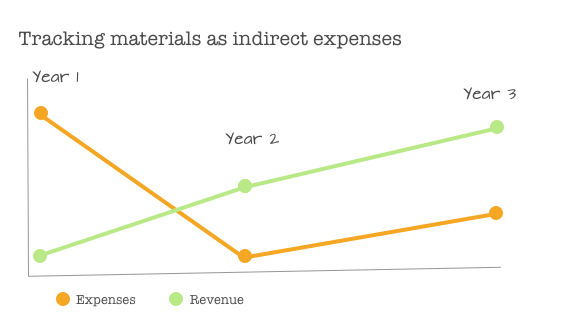
The problem is clear: by claiming materials in the year you bought them, you’ve lost the ability to offset them against the sales they eventually generated. You get a big deduction early, then almost nothing later, right when your revenue is climbing.
Why the COGS Approach Works Better for Claiming Manufacturing Costs
Now run the same scenario using COGS. For simplicity, we’ll use 45% of sale price as a COGS estimate. Your actual figure will depend on your products (see how to calculate COGS for a proper worked example).
Year 1: Sales of $2,000, COGS of $900. Modest deduction, modest income.
Year 2: Sales of $15,000, COGS of $8,250.
Compared to the direct expense approach, you’ve claimed $4,750 more in deductions in Year 2, the year you actually needed them.

Tracking your material costs as COGS using an inventory tracker like Craftybase means your expenses always track your revenue. As sales grow, your COGS deduction grows with them. Your taxable income stays predictable, and you’re never hit with a sudden tax spike because you can’t deduct materials you already burned through in a previous year.
This is the key advantage: COGS creates a constant, proportional relationship between revenue and deductible costs. The expense method creates an unpredictable one.
What About Supplies vs. Materials?
It’s worth separating two things the IRS treats differently:
- Materials are items that are incorporated directly into your products (yarn for knitting, wax for candles, resin for jewellery). These belong in COGS.
- Supplies are items consumed in your business operations that don’t become part of the product (packaging tape, cleaning products, printer ink). These can generally be claimed as direct expenses in the year purchased.
The line can blur, but the principle is straightforward. If it ends up in your product, it’s a material and belongs in COGS. If it supports your process but doesn’t become the product, it’s a supply.
For more on what counts as each, see our guide to inventory requirements for small business.
How Craftybase Helps
Calculating COGS manually from spreadsheets is accurate but tedious, especially when you’re selling across Etsy, Shopify, or both.
Craftybase tracks your material stock automatically as you receive new supplies and fulfill orders. It calculates your COGS in real time, so at year end you pull a report rather than reconstruct your records from memory. Your Schedule C Part III figures are ready to go.
Start tracking your COGS for free →
Frequently Asked Questions
Are materials a business expense I can claim on my taxes?
Yes, materials are tax deductible for maker businesses. The question is how you claim them. You can deduct them as a direct expense in the year purchased, or track them as Cost of Goods Sold (COGS) and deduct them when the products they went into are sold. For most makers, COGS produces a better tax outcome because it matches your deductions to your actual sales revenue.
What's the difference between claiming materials as expenses versus COGS?
When you claim materials as direct expenses, you deduct them in the year you buy them, regardless of whether those materials go into products that sell that year. COGS works differently: you only deduct the material cost for products you've already sold. COGS keeps your deductions in proportion to your revenue, which typically reduces your taxable income more evenly over time.
Can I just expense my materials instead of tracking COGS?
Under Section 471(c) of the tax code, small business taxpayers with average annual gross receipts of $31 million or less can treat inventory as non-incidental materials and deduct purchases when paid. So technically yes, many makers qualify. But qualifying for the exception doesn't mean it's the best choice for your situation. Expensing materials in a high-purchase, low-sales year can create a large paper loss, followed by a painful tax spike in a high-sales year when you have little left to deduct.
Where do I report claiming manufacturing costs on my Schedule C?
Manufacturing and material costs are reported in Part III of Schedule C (Form 1040) under Cost of Goods Sold. You'll enter your beginning inventory, purchases during the year, and ending inventory, and the form calculates your COGS deduction from there. Sole proprietors who sell physical products they make themselves should always complete Part III rather than claiming materials elsewhere on the form.
What's the difference between materials and supplies for tax purposes?
Materials are items that become part of your finished product: wax, yarn, resin, fragrance oils. These belong in COGS. Supplies are items consumed in running your business that don't end up in the product itself, such as packaging tape, printer ink, and cleaning products. Supplies can generally be deducted as direct expenses in the year purchased. If you're unsure, the test is simple: does it end up in the product? If yes, it's a material.
Does Craftybase calculate COGS automatically?
Yes. Craftybase tracks your material inventory and calculates your COGS automatically as orders come in from Etsy, Shopify, and other channels. At year end, you run a COGS report and use those figures to complete Schedule C Part III. There's no manual spreadsheet reconstruction: Craftybase maintains your beginning and ending inventory values throughout the year as you add stock and fulfill orders.
Please note that tax laws change frequently. This information is for educational and informational purposes only and should not be construed as tax or legal advice. Please consult a licensed financial expert in your area with specific questions or concerns.