Bill of Materials Template

Free BOM Template for Excel and Numbers.

Download our free BOM templates for Numbers and Excel: they are ready and waiting for you to start tracking your material usage and costs.

Gain true real-time visibility into your costs of production and put that data to work for your business with our bill of materials templates.

Join the Craftybase mailing list and we'll send you our BOM spreadsheet template for free! We typically send 2-4 emails a month about DTC manufacturing and inventory topics which we hope are useful to our readership.

Bill of materials BOM template

Take your production to new heights with a bill of material template

Create BoMs for your products

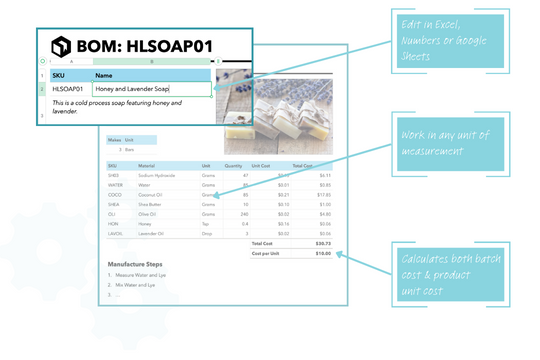
Map out your production process quickly and easily: see exactly what raw materials you need to create each product.

Flexible measurement units

We know every production process is different, our bill of materials template allows you to work in any unit of measure you require.

Automatic BOM calculations

Use our template to automatically generate the numbers you need: cost per batch, unit cost and COGM.

What is a Bill of Materials Template?

A bill of materials (BOM) is an essential document for manufacturers to keep track of the components and materials needed to produce their products.

In this article, we’ll discuss what a Bill of Materials typically comprises, and what options you have for creating your very own Bill of Materials template. Let’s begin!

What is a Bill of Materials (BOM)?

A bill of materials is a structured list of every material, component, and sub-assembly required to make one finished product, including quantities and unit costs.

Let’s start with the basics so we are all on the same page. A Bill of Materials is a complete, itemised list of all the materials, components, and sub-assemblies that make up a final product. It acts as a master document for manufacturers, providing them with an organized and detailed overview of their required materials and is an essential part of any inventory management strategy.

Read more:What is a Bill of Materials: The Ultimate Guide for Manufacturers

Why do you need a Bill of Materials (BOM) template?

A BOM template gives you a reusable structure for tracking material requirements and costs per product, so you can price accurately and plan purchases without starting from scratch each time.

A BOM template helps manufacturers efficiently manage their inventory levels and production processes. With this document, they can easily track which materials are needed when they are needed, and how much inventory is on hand.

Creating your own Bill of Materials template

Several options are available for creating a BOM template - from using pen and paper, through to pre-made excel templates to automated software options. Regardless of which method you choose, here are some key components that a BOM template should include:

Part numbers or SKUs: These unique identifiers help keep track of individual components and materials.

Descriptions: A brief description of each item helps prevent any confusion or mix-ups during production.

Quantities: The number of each component needed for a final product.

Unit costs: Knowing the cost of each material can help with budgeting and pricing decisions.

Suppliers or Vendors: Keeping track of where materials are sourced from is important for ordering and quality control purposes.

Using a standardized BOM template can save you time and effort in the long run, making your manufacturing process more efficient and effective.

BOM spreadsheet templates

Excel BOM templates are also a popular choice for creating a way of tracking your BOMs. They offer more flexibility and customization options than paper-based templates but still require significant manual input and management.

Using pre-made excel templates (like the one above!) can provide a more organized and automated method for creating your BOM. These templates often come with built-in formulas and functions to help with calculations and inventory tracking and are usually free or come with minimal costs.

Here are a couple of free Excel and Word Bill of Material templates to consider as a starting point:

Alternatives to BOM spreadsheet templates

Automated BOM software, like Craftybase, offers an even more efficient way to manage your bill of materials. With features such as real-time inventory tracking, cost analysis, and supplier management, this type of software can greatly improve the efficiency and accuracy of your manufacturing process.

As BOM software typically also includes features such as automatic inventory updates and real-time cost tracking, it tends to be an ideal solution for DTC brands looking to scale and get better control over their production processes.

Benefits of using Craftybase’s BOM functionality

With Craftybase’s BOM template feature, you can easily create and manage your BOMs in the cloud. Simpler process: Our BOM template simplifies creating and managing bills of materials, saving you time and effort.

Accurate inventory management: By keeping track of all your product components, our BOM template helps ensure that your inventory levels are always accurate.

Cost efficiency: With a clear breakdown of all required materials, you can better plan your purchases and avoid overspending on excess inventory.

Enhanced productivity: By having all the necessary information in one place, our BOM template allows you to focus on production and minimize errors due to missing components or incorrect quantities.

As your business grows, your manufacturing process must be scalable to keep up with demand. Craftybase’s Bill of Materials feature is designed for scalability, allowing you to track your raw material and product stock easily, add or remove components and adjust quantities as needed.
Frequently Asked Questions

What is a bill of materials (BOM) and what does it include?

A bill of materials (BOM) is a structured list of every material, ingredient, or component required to make one unit of a finished product — along with the quantity and unit cost of each. A complete BOM includes part numbers or SKUs, descriptions, quantities per unit, units of measure (grams, millilitres, pieces), unit costs, line-item totals, and preferred supplier. For a candle maker, a BOM for one candle might list 200g soy wax, 30ml fragrance oil, one wick, and one jar — each with its cost — giving you the total material cost per candle.

How do I create a bill of materials for a handmade product?

To create a BOM for a handmade product, start by listing every raw material or component that goes into one unit of that product. For each item, record the quantity used per unit, the unit of measure, and the cost per unit of measure — then multiply to get the line-item cost. Add all line-item costs to get your total material cost per finished product. Our free Excel BOM template has all these columns pre-built so you can fill in your own numbers straight away.

What is the difference between a bill of materials and a recipe in manufacturing software?

A bill of materials and a recipe refer to the same underlying concept — a complete list of what goes into making one unit of a product. "BOM" is the term used in engineering and discrete manufacturing contexts, while "recipe" is the term preferred by food, cosmetic, and craft makers. Craftybase uses "recipe" for this feature because it better reflects the language of small-batch makers, but it functions identically to a BOM: mapping materials and quantities to finished products for costing and inventory purposes.

How do I use a BOM template to calculate material costs per unit?

For each material in your BOM, enter the quantity used per finished unit and your cost per unit of measure. The template formula multiplies these to give the line-item cost. Sum all line-item costs to get your total material cost per unit. For example: 200g soy wax at $0.02/g = $4.00; 30ml fragrance oil at $0.08/ml = $2.40; one wick at $0.30 = $0.30. Total material cost = $6.70 per candle. Our free template has these formulas built in — you just fill in the quantities and prices.

Can a bill of materials help me track inventory for handmade products?

A BOM spreadsheet can tell you what materials a product requires, but it doesn't automatically deduct materials from your inventory when you make something — that step is still manual. To get live inventory tracking from your BOM, you need dedicated software. Craftybase links your recipes (BOMs) to your material stock levels. When you record a manufacture, it automatically deducts the right quantities from each material and updates your inventory in real time — no manual spreadsheet edits required.

What is a multi-level bill of materials and when do I need one?

A multi-level BOM is used when one of your components is itself a manufactured sub-assembly rather than a raw material. For example: a gift set product might include a candle (which has its own BOM of wax, wick, and fragrance) and a soap bar (which has its own BOM of oils and lye). The gift set BOM references those sub-assemblies rather than listing every raw ingredient directly. You typically need a multi-level BOM when your products include items you also manufacture yourself — common in soap, cosmetics, and packaged gift businesses.

Take control of your end-to-end manufacturing process and gain real-time visibility into your inventory with Craftybase MRP.

Start a 14 day free trial →

*no credit card required